Josef Haas – Biography of a Danube Swabian from Palanka (Batschka)
Josef Haas (1922–2003) grew up as a Danube Swabian in the Batschka region of the former Kingdom of Yugoslavia and experienced firsthand the suffering and displacement of the Danube Swabians during the Second World War.
Short Description (for reuse)
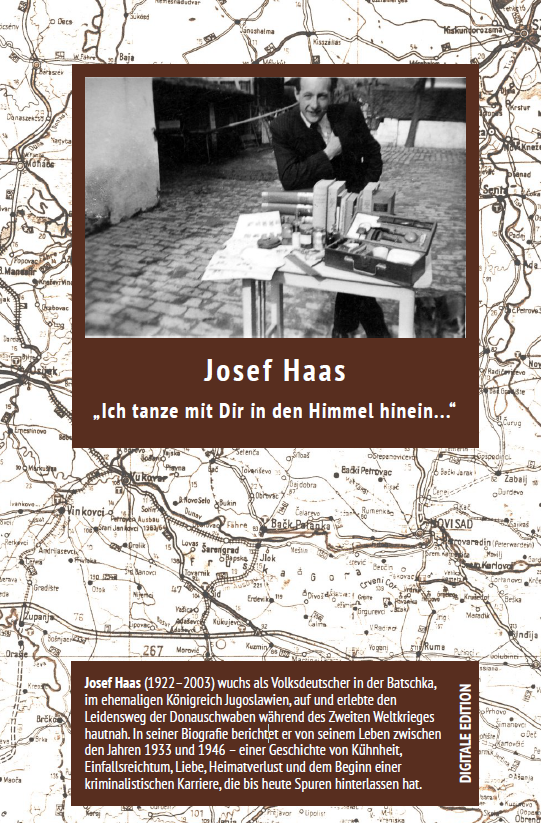
Josef Haas (1922–2003) grew up as a Danube Swabian in the Batschka region of the former Kingdom of Yugoslavia and experienced firsthand the suffering and displacement of the Danube Swabians during the Second World War. In his autobiography, he recounts his life between 1933 and 1946—a story of courage, ingenuity, love, loss of homeland, and the beginnings of a career in criminal investigation that would later leave a lasting mark. His biography stands as a personal historical testimony to the experience of the Danube Swabians. Edited and published by his grandson Alessandro Haas, with careful revision, commentary, and historical notes. Further information is available at: alessandrohaas.de/josef-haas.
Free for reuse on genealogical and historical websites, please include a link back to the source.
Note: A complete English-language edition of the book is currently in preparation and will be released in the near future.
Background of the Josef Haas Biography
The autobiography of Josef Haas traces his life as a young Danube Swabian man in the former Kingdom of Yugoslavia between 1922 and 1946. Raised in the German-speaking community of Palanka in the Batschka region, Josef Haas describes his childhood along the Danube, his training as an electrician, the years of war, the flight from his homeland, the perilous return to Palanka, the rescue of his mother from the internment camp in Schowe, and finally his new beginning as a refugee in Germany and the start of his career in criminal investigation.
The biography was digitized, edited, and supplemented by his grandson Alessandro Haas based on an original typewritten manuscript preserved in the family archive. The text has largely been kept in its original form, carefully smoothed stylistically, and supplemented with historical commentary. The aim was to make the narrative accessible to future generations without compromising its authenticity. The book is further enriched with historical photographs.
The book is available in two formats: a high-quality hardcover edition with thread binding for private collections, and a digital edition for private and academic use.
This life story is more than family history—it sheds light on a long-overlooked chapter of European history. Researchers, descendants, and readers with an interest in Danube Swabian history are warmly invited to get in touch with the editor.
Family Names and Place Names Mentioned in the Biography
This biography of Josef Haas may be of particular interest to you if, in your own genealogical research, you have encountered family connections to any of the following names or places.
Family Names Mentioned
(Selection, not exhaustive – listed in order of appearance)
- HAAS (Josef’s paternal line)
- SCHREIBER (uncle)
- POPOVIĆ (midwife)
- KAPLA (Josef’s maternal line)
- LEIST and ARVAY (godparents)
- MAURER (paternal grandmother)
- ZUGEBER (apprentice)
- BAUER (innkeeper)
- HIEL (relatives who emigrated to the United States)
- WILDE (maternal grandmother)
- WILLER (paternal great-grandmother)
- APPL (maternal great-grandmother)
- TRAGEISER (maternal great-grandmother)
- TIEFENBACH
- POLLAK (maternal great-grandmother)
- WENTZL
- SZEKERESCH (relatives in the United States)
- SCHAGER
- KLEER
- PILLER, ZAR, HÄRING, SCHURNHÄUSER, LAUBER, KLEESPIES (childhood playmates, ca. 1927)
- GAUSS and NUSPL (teachers in Palanka, ca. 1930)
- BAHMER, MOSTHOF (friends, ca. 1936)
- KLEESPIES Franz, MAURER Johann, SCHERER Hans, BOGSCHÜTZ Karl (comrades, killed in Russia, 1943)
- BECK (parents-in-law)
Places and Cities Mentioned
- Palanka (Alt- and Neu-Palanka) – place of origin of the Haas family
- Ilok – family vineyard on the Božino Brdo
- Belgrad – capital city
- Futog – residence of relatives (Nemes)
- Hodschag – residence of relatives (Kleer and Marschall)
- Novi Sad (Neusatz) – regional capital
- Apatin, Sombor, Subotica, Vršac – major towns of the Batschka region
- Kuhberg near Brünn – basic military training
- Wien – advanced military training and engineering school
- Newel an der Lovat, Welikije Luki, Riga, Budapest – stations on the Eastern Front
- Namslau – refugee camp
- Vrdnik – internment of Josef’s father and forced labor in a coal mine
- Schowe (today Ravno Selo) – internment of Josef’s mother and forced labor in a hemp factory
- Gakovo – internment camp where Josef’s grandmother died of starvation
- Karlsruhe – refugee housing and first employment as a criminal investigator
If these names or regions appear in your own family research, this biography may offer valuable clues, historical context, or even direct points of connection. Especially for descendants of the Danube Swabians from Palanka, this life story represents a rare and deeply personal source.
Interested in the Biography?
If you would like to read the biography of Josef Haas yourself, please contact the editor:
Alessandro Haas
aha@alessandrohaas.de
www.alessandrohaas.de/josef-haas
Two editions are available:
- 📕 Print Edition: high-quality hardcover edition, thread-bound (240 pages)
- 💾 Digital Edition: searchable PDF for private use and historical research
I am happy to provide further information or a copy upon request. I welcome correspondence with family researchers, historians, and descendants of the Danube Swabians.
Editor’s Note: On the Making of This Biography
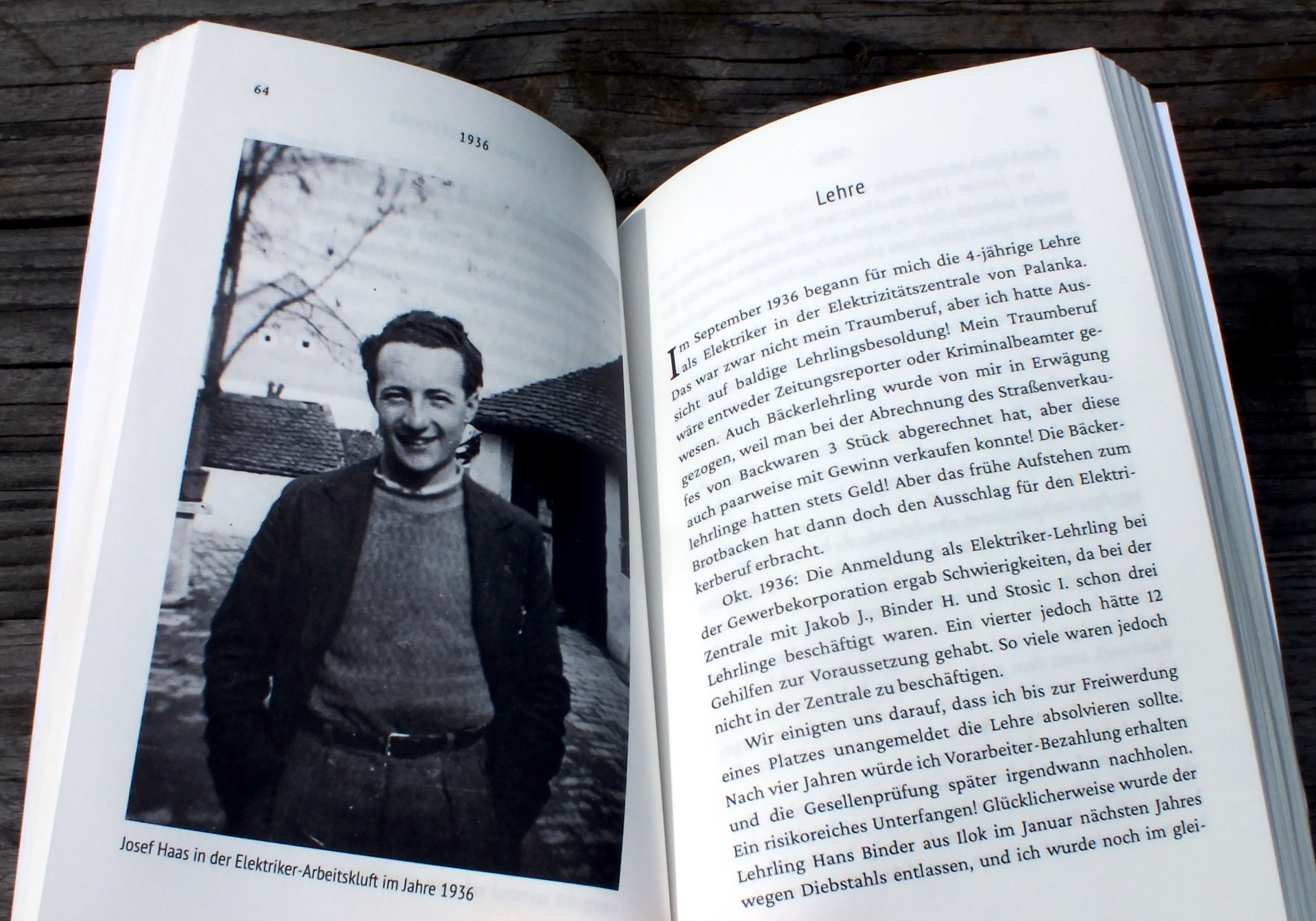
Josef Haas passed away on November 11, 2003, at the age of 81 in Stuttgart. He left behind his life story in the form of a typewritten manuscript, compiled in a black ring binder. This typescript forms the foundation of the present biography.
I began working with this material on December 28, 2005, by digitizing the first pages. The completion of the book and its submission to the printer took place on January 2, 2026—more than twenty years after this work had begun.
My name is Alessandro Haas. I was born on August 6, 1986, in Backnang, Germany, as the son of Bernhard Haas, son of Josef Haas. As a descendant, I made the decision to preserve my grandfather’s life story and to make it accessible in printed form.
The editorial work on this biography extended over many years, with longer interruptions in between. During this time, I completed my studies, started a family, became a father, and moved several times with my family. The majority of the editorial work was ultimately completed in 2025 in Finland, our current home in North Karelia.
During this period, my own family also experienced emigration—albeit under circumstances very different from those described by Josef Haas in his biography. This personal background inevitably shaped my perspective on the text, without altering its content.
Josef Haas wrote his memoirs on a Swiss-made typewriter of the brand SWISSA (manufactured from 1981 onward, Economic typeface Nova 1) and preserved the typescript together with personal data and photographs in a ring binder. For interested readers, the following section briefly outlines how this material was transformed into the book now before you.
Editorial Process
- All pages of the typescript, as well as the accompanying images, were scanned at high resolution.
- The text pages were then converted into editable text files using optical character recognition (OCR) software.
- Due to the characteristics of the original document, the OCR process produced error-prone results. All texts were therefore carefully corrected: first with the assistance of an AI-supported tool, and subsequently through manual comparison with the original pages.
- The text written by Josef Haas was edited only with great care. Orthography was standardized, obvious errors were corrected, and verb tenses were consistently aligned to the past tense. Content and narrative voice remained unchanged.
- To aid the understanding of historical events and contexts, explanatory additions were inserted. These sections are clearly marked as Historical Notes and are typographically distinguished from the original text.
- The photographs contained in the appendix of the original manuscript were assigned to their appropriate places in the running text, digitally restored, and prepared for print.
- Typesetting and design of the entire book were carried out using the layout software Scribus. During this phase, a final round of proofreading was conducted using a printed proof copy.
- Individual place names were cautiously supplemented or adjusted to make them more easily identifiable for today’s readers, without compromising the historical character of the text.
The finished work comprises 240 pages. It was printed on uncoated book paper, thread-bound, and produced as a hardcover volume.
I am deeply grateful to my grandfather for leaving these life records to his descendants. He passed away on November 11, 2003, in Stuttgart-Degerloch. Yet through reading his words and retelling his story to my own children, the memory of him remains alive.
Alessandro Haas
Kuorevaara, North Karelia, Finland
December 30, 2025
Additional Materials from the Family Archive
During the editorial work on this biography, a number of materials surfaced that were closely connected to Josef Haas’ family history but could not be fully integrated into the printed book. The following selection presents some of these documents in their original form.
Two Hand-Drawn Maps of Palanka
Among the preserved papers are two hand-drawn maps of Palanka showing street names and individual house plots annotated with family names. While these maps appears only in passing in the biography, they provide valuable spatial context and are best explored at full size.
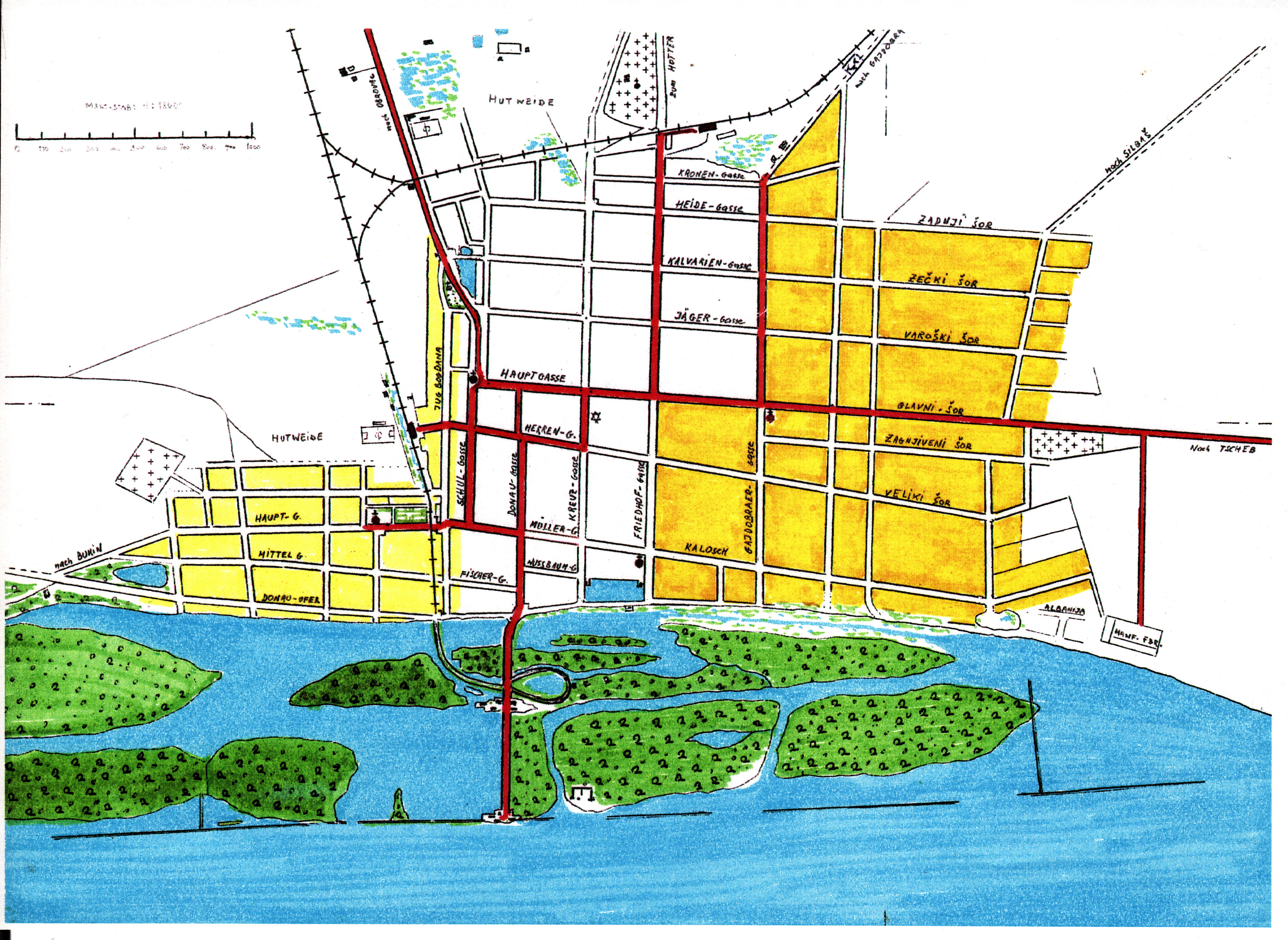
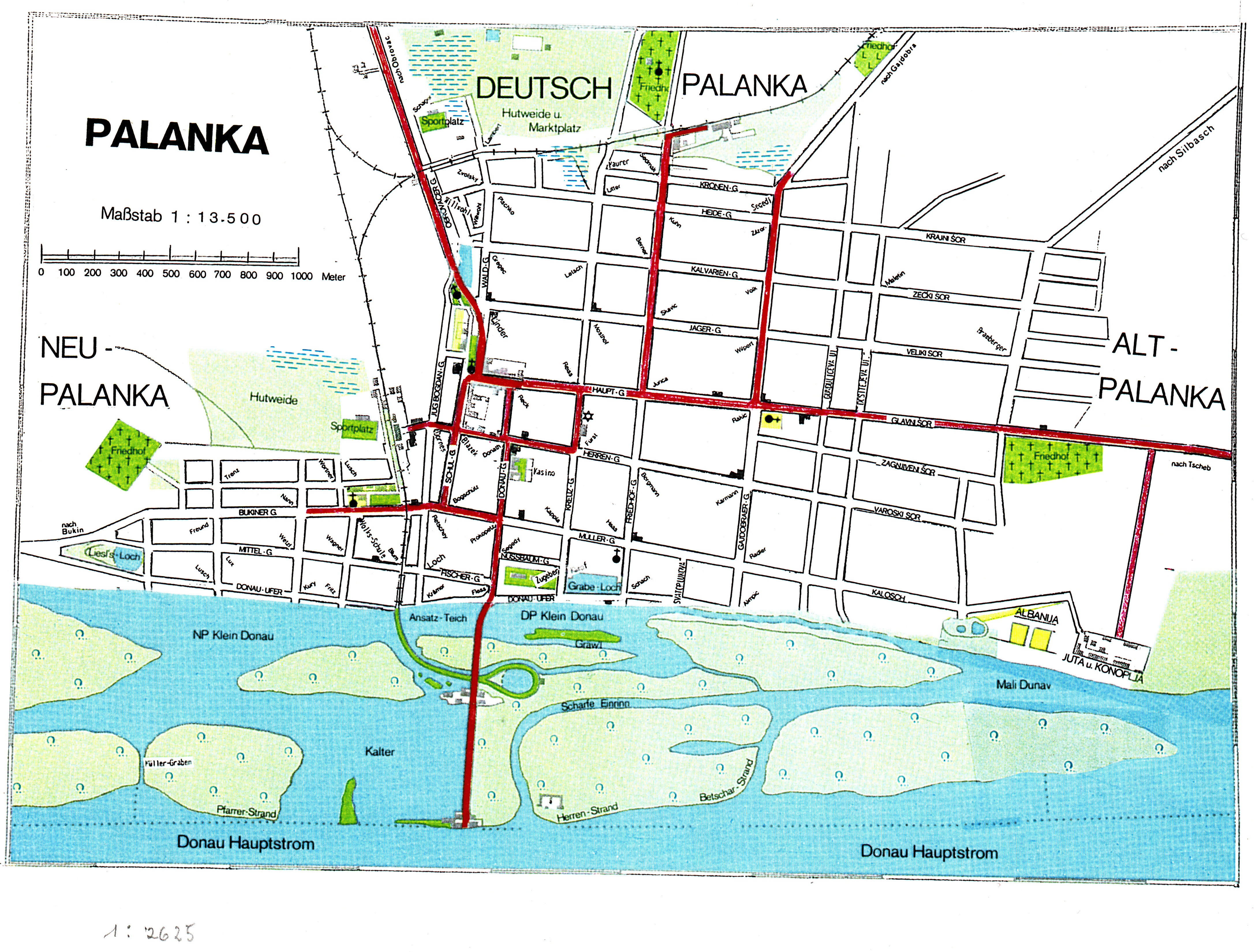
For researchers familiar with Palanka family names, these maps may offer additional orientation or points of comparison with other sources.
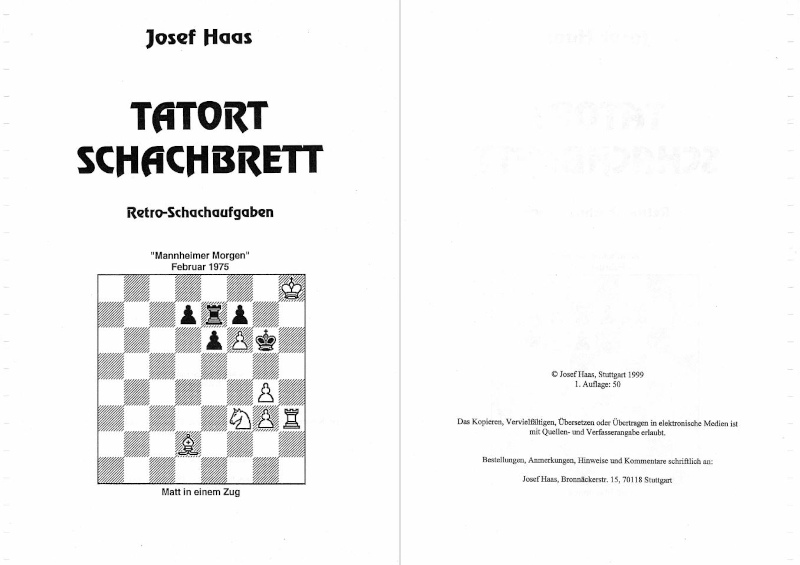
Tatort Schachbrett – A Collection of Retro Chess Problems
With “Tatort Schachbrett”, Josef Haas published a selection of his retro chess problems in booklet form in 1999. The collection brings together two lifelong interests: the analytical precision of criminal investigation and the logical depth of chess problem composition.
The title is based on a criminological method of reasoning adopted by Josef Haas from the German criminalist Dr. Hans Schneickert:
What? Where? When? How? With what? Why? And who?
These questions, which guide the investigation and resolution of a crime, also form the methodological core of retrograde analysis in chess. The chessboard becomes a crime scene, the solver an investigator who reconstructs the history of a position, interprets traces and clues, and determines the decisive final move.
Since the late 1960s, Josef Haas was regarded as one of the formative figures in the field of retro chess problems. He composed approximately 250 retro problems, many of which received awards in highly competitive tournaments. His works are characterized by clarity, logical rigor, and a distinctive sensitivity to criminological “evidence” — qualities that were undoubtedly shaped by his professional career as a criminal investigator and forensic handwriting and typewriter expert at the State Criminal Police Office in Stuttgart.
The selection presented here was initiated on the occasion of his 75th birthday and realized in collaboration with long-time colleagues from the chess problem community. The collection is accompanied by an introductory text that vividly illustrates the parallels between criminal investigative work and retrospective chess thinking. One explicit aim of the booklet was to introduce younger chess enthusiasts to this demanding yet fascinating discipline.
The digital version of this booklet is made available here as additional archival material. It complements Josef Haas’ biographical writings with another facet of his intellectual work and demonstrates the remarkable consistency of his analytical mindset across different domains of life.